







 Credit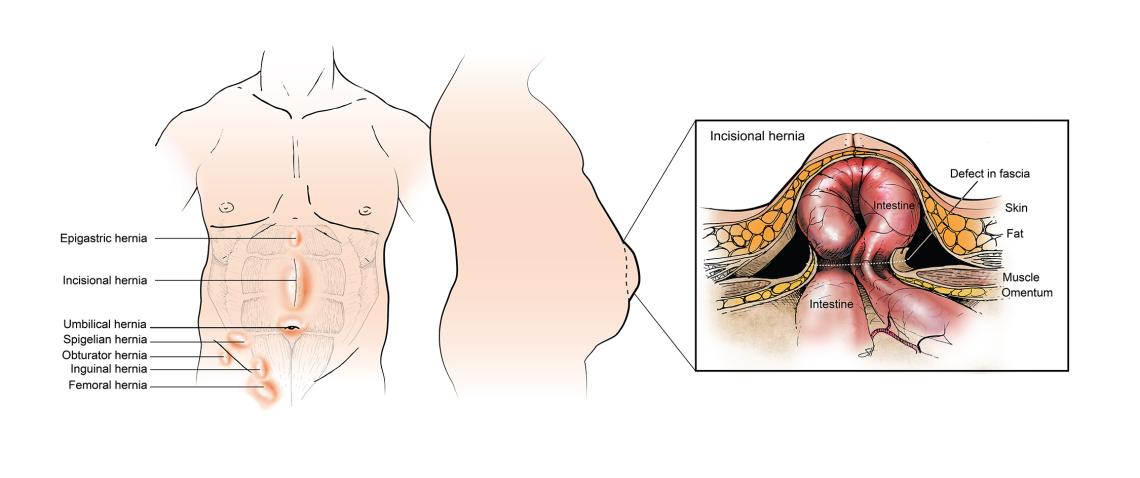
What is a Hernia?
A hernia occurs when there is a weakening in the abdominal wall and internal organs or tissues push through the muscles forming a visible bulge through the skin. Hernias can occur in many areas of the body, most commonly the abdomen and groin. Usually, hernias are quite painful and can be life-threatening if left untreated. Hernias can occur in men, women and children.
What Causes Hernias?
Hernias can have several causes including lifting heavy objects, scars near the hernia site (post-abdominal surgery), chronic coughing, aging, and physical strain during bowel movements. Some hernias are congenital and exist from birth.
What are the Different Types of Hernias?
There are several types of hernias in adults.
Inguinal Hernia - The most common type of hernia is called an inguinal hernia, occurring in the groin area. (see Inguinal Hernia Repair)
Hiatal hernias - Hiatal hernias form through a small opening in the diaphragm that allows the upper part of the stomach to move up into the chest. (see Hiatal Hernia Repair)
There are three types of ventral hernias:
Epigastric hernia - An epigastric hernia (say "eh-pih-GAS-trik HER-nee-uh") is a problem that occurs when a bulge of fat tissue pushes through a weak part of the belly wall. It happens between the breastbone and the belly button, or navel. Epigastric Hernia Repair - Patient Information
Incisional hernia - An incisional hernia is a problem that occurs when a bulge of tissue pushes through the wall of muscle that's holding it in. It happens after surgery in the belly, in the area of the incision. Most of the time, it occurs along a vertical (up and down) incision. It can happen months or even years after surgery. Incisional Hernia Repair - Patient Education
Umbilical hernia - An umbilical hernia is a bulge in the abdominal wall near the navel (umbilicus) that sometimes contains abdominal tissue, a loop of intestine, fat, or fluid. An umbilical hernia may be present at birth or develop shortly thereafter. Umbilical Hernia Repair - Patient Education
Robotic Hernia Surgery
Using the latest in robotic surgery technology, our specialists offer a robotic hernia repair that treats various hernia conditions with less scarring and shorter recovery time. There are many misconceptions about robotic surgery. Contrary to a popular myth, the surgeon does NOT just set up the robot, leave the room, and allow it to do the work. The most used surgical robot is the Da Vinci Robot, which has been around since 1999. This robot is used across a wide range of surgical specialties, and it operates via telemanipulation. This means that the surgeon controls the movements of the robot remotely. The main benefit of robotic hernia surgery is the tiny incision, which cuts down on pain, blood loss, recovery time, and risk of infection.
Hernia Facts
- 10% of people in the US will develop a groin hernia in their lifetime.
- Two million people undergo open abdominal surgery annually in the US. Of these, up to 30% will develop a hernia at the surgical incision site.
- Hernia recurrence rates remain as high as 63% at ten years.
- Patients who undergo multiple hernia repairs have higher recurrence rates and are at higher risk for complications.
- Modifiable risk factors for recurrence and complications include obesity, tobacco use, inactivity, alcohol abuse, and poorly controlled diabetes.